Hinton Martell
alias Hinton Magna or Great Hinton
|
|
Hinton Martellalias Hinton Magna or Great Hinton |
|
|
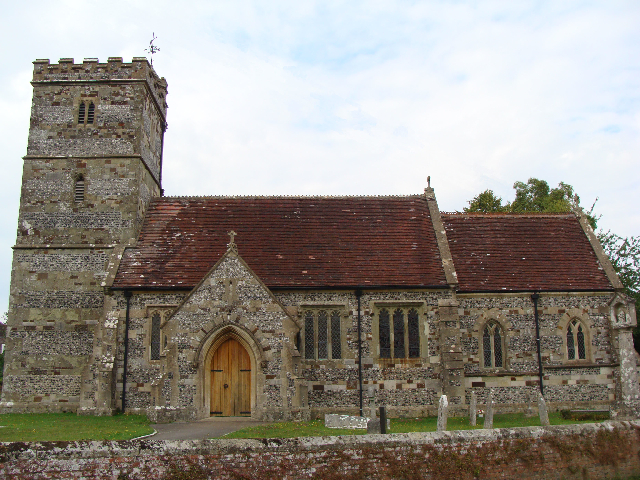
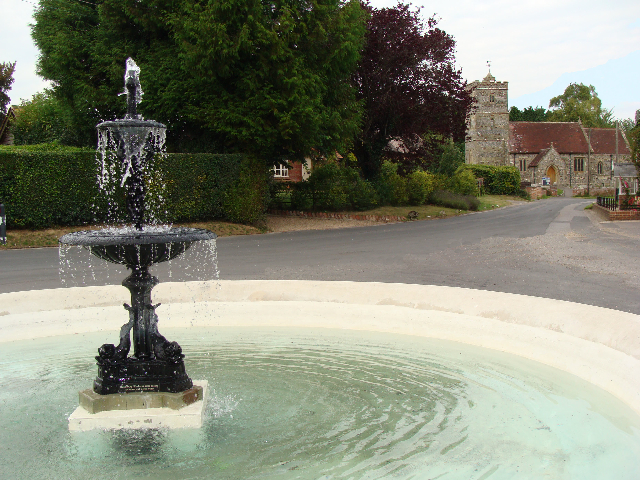
Hinton Martell is a verdant village and parish in the foothills of Cranborne Chase, 4 miles north of Wimborne, known for the curiosity of being the only Dorset village with a Mediterranean-style fountain at its centre, inaugurated by Anne Sidney of Poole, Miss World 1965. Hinton means 'Monk's farm' from Old English 'hiwan' and 'tun', due to links between the monastery at Wimborne and the parish. Martell is a manorial addition from a French family, Lords of the Manor here after the 1086 Domesday Survey at which time the King held 'Hinetone'. Later the parish came to be known as Hinton Magna (Latin) or Great Hinton (English), to distinguish it form neighbouring Hinton Parva or Little Hinton.
|
|
In the mid-1700s the Glyn family started to build up a property portfolio in the area straddling the parishes Hinton Martell, Hinton Parva and Holt. Sir Richard Glyn built Gaunts House in the parish on the site of an ancient house, allegedly that of John of Gaunt. Originally built of Portland stone, in 1809 it was re-faced in red brick to a design by William Evans for Sir Richard Carr Glyn. Then in 1887 George Devey, in the last of his major projects, greatly enlarged and remodelled the house. It is to him we owe the sinister four-storey tower and the delightful row of five flamboyant Flemish-style gables. During World War II, the house served variously as a military HQ and a home for evacuees. After the war the Glyns moved away and the house became a boys' school until 1988, when it was returned to the estate. Since 1989 it has been dedicated to an educational charity.
|
|
|
There have been some real characters amongst the rectors of St John's. Poor put-upon James Crouch was reputed to be the "first sufferer and the last restored" subsequent to the Civil War. The narcissistic Philip Traherne, brother of the more famous Thomas, mislaid the latter's body of work - a wealth of poetry and mystical writing, so that they were lost for 200 years. He wrote the entries pertaining to his parishioners into the register in ordinary ink (now faded) but those pertaining to his own family in brilliant, indelible ink (still very legible). Then there was the assiduous William Barnard who campaigned for the restoration of the medieval spelling of Martell (without the second 'L'), to align it with that of the town in France, from whence the ancient Martel family hailed.
|
|
|
|
| Census |
1841 Census [Keith Searson] 1851 Census [Jennifer Dando] 1861 Census [Keith Searson] 1871 Census [Christel Muncaster] 1881 Census 1891 Census 1901 Census 1911 Census |
| Parish Registers |
Baptisms
1566-1589
1590-1614
1615-1677
1678-1812
1813-1858
1859-1903
[Ros Taylor] Marriages 1566-1589 1590-1614 1615-1677 1678-1811 1813-1837 1837-1921 [Ros Taylor] Burials 1566-1589 1590-1614 1615-1677 1678-1812 1813-1992 [Ros Taylor] |
| Trade & Postal Directories | |
| Other Records | Poll Register 1921 [Ros Taylor] |
| Photographs | |
| Monumental Inscriptions | |
| Maps | |
|
View Larger Map |
|
| Records held at the Dorset History Centre [Ref PE-HIM] |
Registers Christenings 1566-1903. Marriages 1566-1992. Burials 1566-1992. |
| Registration District
(for the purpose of civil registration births, marriages & deaths) |
1 Jul 1837-31 Mar 1937: Wimborne 1 Apr 1937-30 Jun 1956: Blandford 1 Jul 1957-31 Mar 1997: Poole 1 Apr 1997-17 Oct 2005: East Dorset |
|
|
|
|
Visitors to Dorset OPC
Copyright (c) 2025 Dorset OPC Project